Q&A with Janis Robinson Daly, Author of Under Two Flags
Posted on March 4, 2026 in Interviews, Newsletter
Q&A with Janis Robinson Daly, Author of Under Two Flags
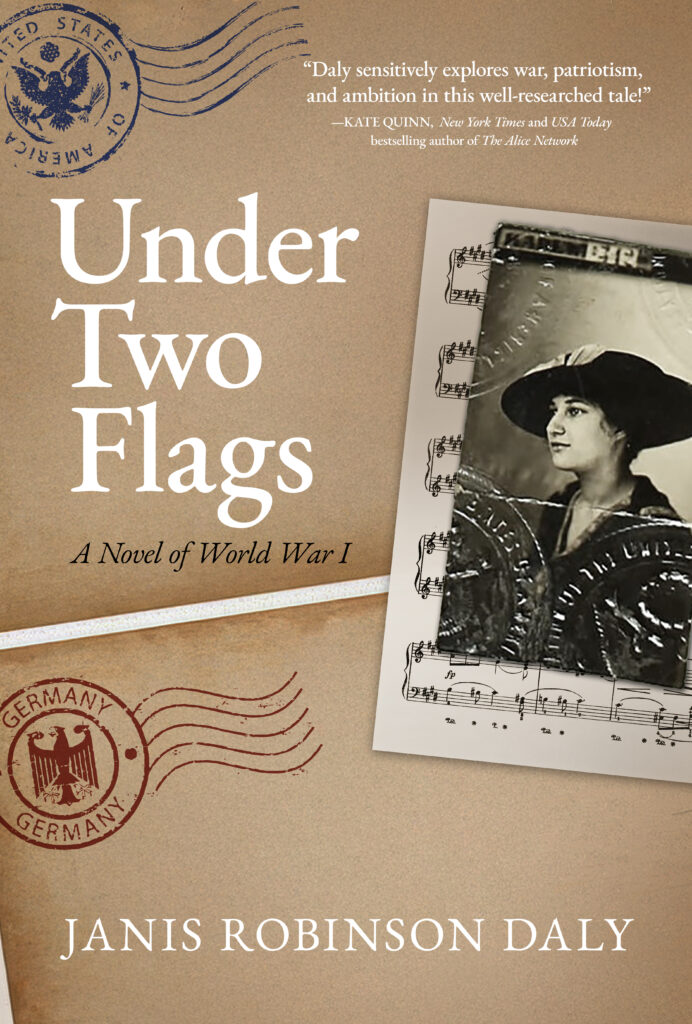
For Women’s History Month, I’m delighted to share my conversation with Janis Robinson Daly, author of Under Two Flags: A Novel of World War I. Based on the memoir of Josephine Therese Marzynski, the novel follows a young woman who travels from Boston to Berlin in 1916 to pursue her dream of becoming an opera singer—only to find herself stranded when the United States enters the Great War.
You can learn more about Under Two Flags and purchase the book here:
https://janisrdaly.com/books/under-two-flags/
The title, Under Two Flags, beautifully captures the tension your main character, Josephine, faces. What does it mean for her to live “under two flags”? Is the reference political, emotional—or both?
Josephine’s original memoir entitled, With Old Glory in Berlin, emphasized her steadfast belief in American ideals. I wanted to reach further and convey her experiences as an American, with those ideals, living in Berlin, under Prussian rule. When the United States entered the war in April 1917, everything changed overnight. She could no longer speak English in public; even her American-made boots triggered suspicion. Her daily life transformed immediately as she became an enemy of the state. At the same time, her loyalties divided between the country of her birth and the land that had embraced her immigrant parents and Germany and its people which opened their doors to her musical dreams at one of the world’s finest conservatories.
Josephine’s loyalties are tested—by friends, by circumstance, by history itself. What kinds of impossible choices did women like her face during the war?
For women like Josephine, and all women living in a country at war, choices became mere illusions. Rationing dictated how much food, clothing, and household supplies a family could have. She must decide which child gets the single egg for breakfast. Who in the family most needed shoes to cover their bare feet? Where could she find another blanket to put on an elderly parent’s bed when coal had been confiscated? Beyond the home, conscription demanded the sacrifice of sons, husbands, fathers, and brothers to the front lines. Women had no choice but to watch them march away in an endless parade in the name of the Kaiser, left to endure the waiting and worrying with stoic and quiet heroics.
Historical fiction often restores complexity to women whose stories were reduced to footnotes. What do you think modern readers will most relate to in Josephine?
Across time, women have fiercely embraced and nurtured their passions, even when history pushed them into the quiet shadows. Modern readers will recognize themselves in Josephine’s determination to hold fast to her passions. Whether pursuing her dream of becoming a professional opera singer or remaining true to her American ideals, she refuses to surrender. Her resilience, her ambition, and her unwillingness to let circumstance define her feel strikingly contemporary.
In writing Josephine’s journey, were there moments when you felt her stepping beyond the limits imposed on women of her time?
Whenever Josephine dared to use her voice, off the stage, I cringed with fear for her. Challenging a German businessman, speaking English when it was forbidden, even singing an aria in banned French, each instance carried a real risk. In those moments, she stepped beyond the rigid expectations that women should remain silent. Her defiance was the quiet insistence on being heard.
Under Two Flags is based on Josephine Therese Marzynski’s memoir. How did you come to read the memoir?
I discovered With Old Glory in Berlin when my brother showed up on my doorstop with an original 1918 edition he’d pulled from his bookshelf, tucked alongside copies of our grandfather’s novels. Although Josephine’s name graced the cover, the foreword was written by the book’s editor, Eliot H. Robinson, our grandfather. As I read the book, it became clear he had done far more than edit. The voice, cadence and style mirrored his fiction so closely that I surmised he had essentially ghostwritten the memoir.
What kind of research did you do to bring 1916 Berlin to life—especially the conservatory and music culture?
Josephine’s memoir provided the foundation, but I turned to additional resources to further develop her character and responses to various scenes in 1916 Berlin. Another memoir, An English Wife in Berlin by Evelyn Mary Blücher von Wahlstatt, offered vivid, firsthand detail about daily life of another enemy of the state during the war. To capture the musical influences, I relied on 100 Great Operas and Their Stories: Act-By-Act Synopses by Henry W. Simon, choosing specific operas or arias which reflected the emotional tone of key scenes. I then sought out performances on YouTube videos to listen to and reflect on the music’s texture and feeling to complete the emotions the music evokes.
Shifting gears, you are the creator of the wonderful #31Titles Women in History initiative celebrating Women’s History Month. What is #31Titles and what inspired you to begin it?
There’s a quote from Anita Diamant, bestselling author of The Red Tent, which I’ve tucked into the back of my mind ever since I read it in an article about her ten to fifteen years ago: “I believe that women’s history and women’s stories are still under-told, which means that there’s a hunger for them.” As I prepared to release my first historical fiction, The Unlocked Path, I searched for comparable books to assist with its listing on Amazon. While I couldn’t find many other books based on real-life women doctors at the turn of the 20th century, I did find several biographical historical fiction titles about lesser-known women. As a professional marketer, ideas began to churn. March is Women’s History Month. My book would have been out for six months by then and would need another promotional push for awareness. But what about those other books I had found? They also honored women in history. Could I find thirty other books to create a list to celebrate Women’s History Month? I did and launched #31titleswomeninhistory in 2023. The list also celebrates the women authors who found these women and told their stories through historical fiction by combining the facts of exhaustive research with imagined emotional responses as the women strode forward with dreams in their minds and hopes in their hearts.
For those who want to dive into Under Two Flags, Butterfly Games, and all the other novels spotlighted in #31Titles, where can readers find out more?
The 2026 list, plus the lists from 2023, 2024, and 2025 can be found and downloaded from my website. Additionally, readers can follow me on social media where each day in March I will spotlight one of the titles. (@janisrobinsondalyauthor on Facebook and @janisrdaly_writer on Instagram). I’ll also be presenting the list as several live and virtual events throughout the month. You can find those events on my website: www.janisrdaly.com/events/
My thanks to Janis for sharing the story behind Under Two Flags and for the work she does each March to spotlight women’s stories through #31Titles Women in History. These novels remind us that history is richer when we listen to the women who lived it.